De Courville Estate
One Thousand and One NightsDe Courville Estate is the stately Shub-Haramb home of Della de Courville and her parents, and the setting of a crucial discovery in Tad’s investigation. Its carefully tended grounds and bustling household conceal a secret room, a disguised staircase, and a treasure chamber where Della’s father reveals how the Magic lamp, fairy gold, and the threat to his daughter are bound together.
Setting and Household
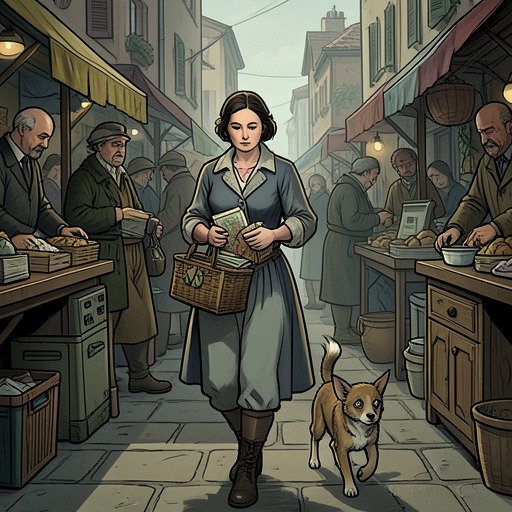
The estate stands in a large three-story house against the backdrop of Shub-Haramb. Its grounds are expansive and formally maintained: gardeners work among hedgerows and flower beds in a style Tad considers unlike the city’s usual character. The property’s grandeur marks the family’s wealth, while its gardens and statues provide Tad with cover as he secretly follows Zaen toward Della’s parents.
The household is active and inhabited rather than merely impressive. From a small room near the kitchen, Tad hears clattering, laughter, and a cook shouting orders; servants bustle through the property, and gardeners tend the grounds. Della’s mother walks outside with her husband, dressed splendidly beside him. The contrast between this open, cultivated estate and the concealed chamber beneath it gives the house two distinct faces: a visible home organized around family and service, and a hidden space shaped by secrecy and past dealings.
The Secret Entrance
Tad first loses sight of Zaen and Della’s father after they disappear behind the side of the house. He follows them into a dim, sparsely furnished room that seems to be a storage area just off the kitchen. A single candle lights the space; there are no shelves, only a pile of straw. Although a staircase winds upward, it ends abruptly at the ceiling, and Tad reasons that the two men could not have gone that way without his hearing or seeing them. The room’s emptiness makes their disappearance more puzzling: its ordinary appearance offers no obvious explanation for where they have gone.
The Magic globe later supplies the missing action. Zaen shuts the room’s door while Della’s father takes a small device from his pocket and lights two candles on the wall. Carrying one of them, he approaches the straw and says, “Open sesame.” The rug lifts to reveal a staircase below it; after both men descend, the rug settles back into place. The entrance turns a household furnishing into a concealment mechanism, transforming an overlooked corner of the estate into access to a private underground chamber.
Treasure and the Missing Lamp
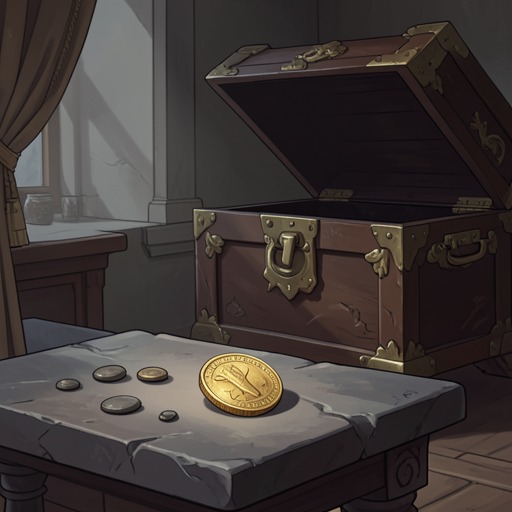
Below the house, candlelight makes the chamber seem to glow as if its walls were gold, but the apparent radiance comes from the treasure piled inside. Zaen notices that the thief has taken little. Della’s father explains that a fortune in fairy gold has already been stolen before he realized the Magic lamp was missing, and he suspects the thief may return because the entire hoard could not be carried away at once.
The chamber distinguishes deceptive wealth from actual wealth. One pile resembles straw spun into gold, but Della’s father calls it worthless fairy gold: its nature becomes apparent only when it is taken a considerable distance beyond the city, a limitation he associates with the Jinn’s territory. Nearby are real coins and gems, of which only a few handfuls are missing. The hidden cache therefore contains both the evidence of an apparent fortune and a more conventional treasure, while the absent lamp points toward a supernatural danger not explained by the stolen valuables alone.
Family History and Consequences
As he explains the chamber’s history, Della’s father connects its treasure to his earlier dealings with Rumpelstiltskin. He says that he found the lamp after following two magical creatures to a cave and hearing the words that opened it. The local story promised that the lamp could make wishes come true, but no one had explained the cost. His first wish gave him knowledge of how to acquire wealth rather than wealth itself; his later wishes culminated in sending Rumpelstiltskin back into the lamp. The bargain nevertheless left the imp with a claim on the father’s firstborn child, a demand he refused to exchange for another arrangement.
The estate’s underground treasure also helps explain why the threat to Della is not simply a question of money. Della’s father believes Rumpelstiltskin’s possession of his mother’s necklace and his father’s ring proves the claim; when Della turns twenty-one, the imp will be able to claim her, and what she inherits will pass to him. Her father wonders why the creature would want the inheritance when it can make its own wealth, while Della’s mother suggests that the fairy gold may be all it can produce and that the real fortune was meant to provide for their daughter. The chamber thus makes the family’s inheritance visible even as the dispute over its meaning remains unresolved.
After inspecting the treasure, Zaen takes a small handful of real gold coins, and he and Della’s father return upstairs through the concealed passage. Outside, they cross the lawn to Della’s mother, who is sitting unhappily by a flower bed. Della’s father introduces Zaen as his new treasurer, praising his quickness with numbers and describing him as too valuable to remain a groom. The discovery below the estate consequently leads back into the family’s visible life: the hidden wealth gives Zaen a new position in the household, while the parents’ conversation makes clear that Della’s future remains under threat.
Narrative Function
The estate’s design makes concealment a practical part of the investigation. Tad can observe Zaen and Della’s family on the grounds, but the crucial evidence lies behind a door, beneath a rug, and below a room whose staircase appears to lead nowhere. The progression from garden to kitchen-side room to treasure chamber deepens the mystery by stages: first the house presents an ordinary domestic surface, then an unexplained disappearance, and finally the hidden history that connects the Magic lamp, fairy gold, and Della’s inheritance.
The concealed chamber is therefore more than a storehouse. It gathers the consequences of Della’s father’s wishes in one physical place: the fruits of his attempt to obtain wealth, the fairy gold associated with the Jinn, and the larger fortune that could pass to Rumpelstiltskin through his claim on Della. Yet the passage back to the lawn places these private dangers beside ordinary family gestures and the promise of Zaen’s employment. De Courville Estate holds together the domestic and the uncanny, showing how a secret made in the past has entered the family’s home, inheritance, and present-day choices.